21 August 2009
24 February 2009
0
I'm alive.
Don't really know where to start..
It has been a very colorful year.. much reading and not much writing. Yet so much to write about.
So, the crown princess has been engaged to an ordinary people's person. Good for her. And good for Him. If you want to be a king, then start a fitness center, is all I can comment on this.
The rest is their private matter. I mean, the parliament has to approve their wedding, come on...
What century are you people living in?
Read More......07 March 2008
1
Lost constant
Yesterday I spent most of my afternoon writing the review of the book for my university course. That is why the post is called Deadlines, deadlines. Deadline has been met, so now I can write down some of the brainstorming, that modern TV media leaves me with every week with the mystery sneaking of of the TV show Lost. My favorite one, definitely.

So, just before I dive into looking the recorded latest episode of Lost, the sixth one in Season 4, I will reflect a bit on the last week's episode, the Constant.
The lost writers introduced the idea of time travel, where the concept itself is not a physical travel, but a sort of a dreamy trip. Time travel here is a consciousness jumping back in time into the body, and not the body itself. A body is just a container, being used as a station in time-travel. The consciousness is being initiated and it goes back to a place in timeline, where it fixes things, and changes the events in it's future-to-come. Authors are specific in their idea of time travel into future not being possible, while going back in time is possible.
The question is, whether all flashbacks, we have seen so far, are really just flashbacks in someone's memory, or, they are actually limited time-travels initiated by the island's powers.
You can not change the future.
This Faraday's line Is a part of an interesting mind-game here. Going back to past enables changing the present UP to the point in time, from where the time-traveler goes back to past. So, Lost's time-travel concept has limitation future-wise. Well, it remains to be seen.
 Is Daniel Faraday's time on island his present, or is it him going back in time, in order to fix something in his yet-to-come present? Now, this was a brave piece of thinking. Desmond being Daniel's constant can be something Daniel Faraday is yet to learn in his future, from which he travels back in time to the Losties present in 2004. The point is that it does not have to be something he wrote in his diary back in 1996, after he had met Desmond's consciousness, traveling back in time to initiate Faraday, and become his constant. Writers certainly do leave a space open just enough for various options to take place in future episodes. My theories might be possible, if we follow the time-travel pattern, given so far in the Lost.
So, to cut a long story short, going back and forth in time has a limitation, when it comes to the forth-part of travel. It is like a writing down a book. If you decide to change something in the story, you are free to go back to certain page and change the story, a sentence, a word, a letter, or a comma. However, changing the pages in future is impossible, because these pages do not exist yet. They have not been written. That is my Lost theory for this week. Huh?
 A final, not-cleared piece of thinking here is following. When Penny answers Desmond's call from year 2004, she does not specify what year it is for her. She says, however, that she has been looking for him for three years. That might fit into the Lost story, where the Flight 815 crash takes place in 2004, and three years later, in 2007, she receives Desmond's call. Is this Desmond making the telephone call three years into outer world's future? If theories about time passing slower on the island, than in the real world, are true, then we might see those Losties who having left the island are going directly into the 2007. Wow, what an inspiration!
OK. Thanks for your attention. Now, I am off to the new Lost episode!
Read More......06 March 2008
0
Deadlines, deadlines!
In between the Statistical Analysis Software programming sessions, I have been reading a very interesting book about perspectives of modern technology. How the new electronic gadgets and Web-based services influence, shape or threaten our way of life? Why do we engage in virtual communities? How good have we been in predicting a future technology? What kind of technology is yet to come? What is the attitude of the culture towards technological progress? Where does the Internet fit into the globalization process? These are some of the question that this anthology's essays arise.
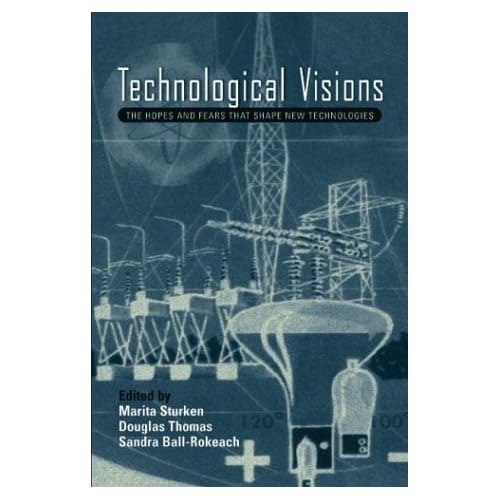 The book Technological Visions: The Hopes and Fears that Shape New Technologies is a result of a project funded and covered by the Annenberg Foundation through three foundation's organizations. Both Annenberg Schools for Communication, at the University of Pennsylvania and at the University of Southern California, as well as The Annenberg Center for Communication at the University of Southern California, contribute a majority of authors in this volume.
A selection of studies for this book has been made by then three professors in the Annenberg School for Communication at the USC. Marita Sturken, Douglas Thomas and Sandra J. Ball-Rokeach are also multiple books authors. M. Sturken teaches now at the New York University.
Out of book's18 essays, I picked two for my review. My selection of essays has been made, partly based on a fact that I am regularly participate in a few virtual communities, partly on my primary educational program at the university, and that is statistical and data analysis.These two essays are: When the Virtual Isn't Enough by Katie Hafner and The Globalization of Everyday Life: Visions and Reality by group of authors: Jennifer L. Gibbs, Sandra J. Ball-Rokeach, Joo-Young Jung, Yong-Chan Kim, and Jack Linchuan Qiu.
When the Virtual Isn't Enough
Katie Hafner describes similarities and differences between a real-life community and a virtual community on two vibrant examples. A 2500 residents of the town of Williamsburg, Massachusetts, turned out to be impressive and so much needed support for the author in times of mourning after her tragically deceived father.
Five days after the accident, 200 people, perhaps even more, walked up the hill to the town cemetery to attend Neil's graveside funeral. A month later, at a gathering at my father's house following his memorial service, women from the church materialized, like angels out of nowhere, to serve food and clean up.
Williamsburg is a small community, where people virtually know each other's secrets. Regardless, their care for the offspring of one of "theirs", late Neil, was a healing factor for Katie. She says that after she had spend a week in a town, she did not want to leave. Even though she did not know these people well, they kept her safe and warm.
When I did leave, although I stayed in touch with many of these same people by e-mail and telephone from northern California, I felt too far away and wanted to return.
She describes how her staying in her late father's town gave her better insight of the meaning of the community. The interesting part is that, prior to the describe event, she had been studying a case of a well-known virtual community WELL for years. It came naturally for her to compare her experience regarding the virtual and the real in a domain of what we call community.
The name for the WELL is a handy word puzzle. Well stands for The Whole Earth 'Lectronic Link. Also, when added a domain extension ".com", we pronounce the whole web-address as "www welcome", that, I must say, obviously, sounds welcoming enough. The web address, itself, is www.well.com.
The WELL is a virtual community. It was started back in 1985 in California by web-veterans Stewart Brand and Larry Brilliant. Several well-known names were part of the WELL community, such as John Perry Barlow, John Gilmore, and Mitch Kapor, the founders of the Electronic Frontier Foundation, or even Kevin Mitnick himself, to name a few. It may be worth to note that Kevin Mitnick was refused to extend his membership in the WELL in March 2007. Does that speak of WELL's high morale or hypocrisy, judge for yourself.
Author speaks about the WELL as a community, which despite of being virtual, inherits many characteristics of a real-life community. It has it code of behavior, an established format for posts, it's "do's and don't's".
Just like in real life exist individuals, who oppose established social boundaries, and who, by expanding them according to their standards, impose the new standards, and become famous just for that fact, the WELL had it's star. The author focused her research of the virtual community on one member, who she calls the quintessential member. Tom Mandel was THE single most important and visible member of the community. He worked at Stanford Research Institute in Menlo Park as a futurist, one of the first to receive such a degree in USA. He was smart, fast in typing on a keyboard, temperamental and eclectic, as the author says. He was a real hero and star of the WELL, a sort of an early model for other virtual community eccentric members.
Mandel's more or less continuous presence on the WELL made him something of an ever-present force. He provoked, bullied, jeered, one-lined, and pontificated his way around the WELL.
Doesn't this sound familiar? Nowadays, every Internet discussion forum, that has achieved a critical mass of members, gives a sort of birth to it's own hero. Discussion forum is a media-content channel for it's users, and every media has it's own stars. Be it TV-channel, radio station, web-portal or newspapers, there is always that distinguished individual, who's persona brings it on.
Tom Mendel resembles in a way a TV performance artist Andy Kaufmann, or a 1990s MTV star Tom Green, or a modern satellite-radio- and tv- and media- star Howard Stern, to mention a few. Every single one of them were setting the new rules for others to follow in their respective media. Furthermore, they were having fun, along the way.
Author comes to a conclusion that virtual communities cannot replicate the real thing. It was her father's death, that enabled her to experience the irreplaceable:
... a sense of place, a sense of belonging, in a physical way.
... want to gossip about marital troubles of those nasty neighbors...
... want their new car to be seen...
This essay learns us that virtual communities are a replacement, or a sort of an artificial extension for a missing chunks of life. They, communities, are addictive, they are safe, and anonymous. They ultimately remain virtual, but not real.
The other chosen work from the book Technological Visions, that I chose to review, is an analytical essay:
The Globalization of Everyday Life: Vision and Reality.
This is a final essay of the book, a joint analysis of communications aspect of globalization. A team of researchers from the University of Southern California, under the Metamorphosis Project research how modern technology affect lives of several ethnically selected and geographically separated focus groups of people in a wider residential area of Los Angeles. Following ethnic groups have been researched: Caucasian/Protestant, Caucasian/Jewish, African American, Mexican, Central American, Korean, and Chinese.
Jennifer L. Gibbs, Sandra J. Ball-Rokeach, Joo-Young Jung, Yong-Chan Kim, and Jack Linchuan Qiu performed a quantitative and qualitative analysis in this study, and revealed some interesting results.
When describing the term globalization, the groups' description of term is highly similar when it comes to language. However, perception of globalization varies from highly positive, among African- and Central Americans, to skeptical among Korean-origin focus group. Chinese-origin focus group was ambivalent on this issue.
Caucasian groups' ambivalence towards globalization is additionally explained by cynicism based on injustice, that comes with globalization process. They consider the Internet to be both positive and dangerous: "a double-edged sword".
Most interesting results were received when it comes to modern technology-based communicational habits of focus groups. Study results for all groups differ accordingly to the generation of immigrants. Internet communication behavior of first- and second- generation immigrants is different from those of third generation or more. Authors use the term ethnoscapes by Arjun Appandurai, by which they describe ability of ethnic displaced groups to reconnect to their homeland via available communication technology, whether it is Internet or traditional media.
The study shows that the global Internet connections are global to extend of ability of ethnoscapes to inner-communicate. This means that, unlike globalization technological vision, groups use modern communication technology to reconnect with home country.
Finally, the most important conclusion of the study is that the global Internet interconnectivity does not alter people's lives in a way, that the actual physical migrations bring people with various ethnic and cultural background together . The ethnicity remains strong dividing factor between people even on Internet.
What a defeat for us all, I must add...
Read More......04 March 2008
0
They have no idea
I have just received a customer service e-mail from my cell-phone producer. It's Sony Ericsson. In my free translation from Swedish, it says:
Dear Mirza,
I am sure that you are still fascinated with your k750i. Have you already checked how much more your phone can do?
I am not sure whether these people read my posts, or what?
I just suddenly feel compelled to state officially that my phone is NOTHING like the device they sold me. At least from the inside. As for the outside, it is worn a bit, but, as I wrote a week ago, it has grown to a monster, hidden in a deceiving k750i-shell.
Furthermore, they advise me to visit their corporate web site,
where you will find a number of products and services, that will help you to get the most of your phone.
Needless to say, phone users community-driven sites and applications have already lifted the phone to the next level, and upgraded phones' capabilities beyond the company's paid services. But wait, there is some common sense here:
What do you say about the free-of-charge online tools for...
This one came as a surprise! It is nice that company offers free tools, it is just that these tools have been available online for "ages". These have been written by and for the users community. The corporation has been widely by-passed by smart users, who share their knowledge among themselves, but not with the corporation itself.
I bet that Sony-Ericsson cannot figure our why I still have my old, nearly three-year old model, instead of getting in line, and consuming their latest, and not necessarily always better gadgets.
Oh those poor corporations! They have no idea. Will they ever learn?
Read More......26 February 2008
4
He would have turned 77 today
Ever since I had learned counting days, weeks, months and years, I could have never correctly guess my parents' birthdays. It is not that I have a memory related or a calculus problem. It is a simple fact that they both were born in February. As long as I remember, their birthdays were sort of same to me. Here they are, February 4th and February 26th. As far as I am concerned, those dates have sounded to me as real as February 6th or February 24th. My brain does work in mysterious ways indeed. Furthermore, it is not just the that February-something digit problem I have had since forever. Year after year, I kept forgetting which birthday was to come first in February, my mother's or my father's.
In November 2005, my father passed away. In an emotional shock, that I went through, I was kind of enlightened by the fact that his birthday was actually easy to distinct from my mother's. He was born in 1931. Last two digits, when multiplied, give 62. When I switch the digits in 62, I get 26. And that is his birthday, the February 26th. On the other hand, my mother was born in 1942. The last two digits are 4 and 2. Need I say that her birthday is 4th of February? So here they are, those dates. I could not see it through, all these years.
I am not sure which one to wonder more about, the fact that it took me 30 years to figure out the way to remember my parents' birthdays, or, the wondering way, that their years of birth are interconnected with their birthdays.
I do have this thing with digits, I kind of see them. My perception of the world I live in somehow intercepts with numbers, that at the end of the day come down as a silent explanation for the things I cannot rationally explain. Do not ask me what I mean with that sentence. It is the way my brain works.
And the very fact, that I am writing about digits on my late father's birthday does not mean I love him less. It's just the way my brain works. I might have as well just expressed my love to him. Read between the lines.
Had he lived longer, he would have turned 77 today. I miss him so much.
0
Yes, We Can... Take This Blog Away!
Imagine this ultimate spin: Barack Obama helping promote my blog?!
I am not sure if that has been done before. It fits perfectly my post, I must admit. Plus I got that momentary inspiration I cannot resist, so it may be worth the buzz. Look at it this way: I get a helping hand from a famous politician and you get to see all those beautiful celebrities in the YouTube Obama music video. And, I like the message he is spreading. Do you? Lets play the tune. Than, I will tell you what this post is all about, and you might even end up actually LISTENING to all this.
The real question of this post is following: Do you like reading? I do. What else can you do while reading? Anything? Can you read a book and drive a car? No? Well, yes! You can. Make your change - from reading to listening.
Now, I will ask again: Do you like reading blogs? Do you have all the time you need to read your favorite blogs? Huh? Err. I thought so. And how about you actually listening to mp3 blog? Just like a podcast!
Here's the best part. You CAN take this blog away with you. Just like takeaway pizza. Yes, I am that cheap!
Start subscription and dare to listen to this magnificent blog on your gadget of choice by clicking the "audio blog - podcast" banner above the top post or just click here, and choose your RSS reader or media manager, Mediamonkey, iTunes, Winamp or your audio software of choice. The smart brains from Odiogo made this magic possible.
So go ahead, make my day and take this blog away!
Read More......
Subscribe to:
Posts (Atom)